For multifamily property management organizations, resident phone coverage is often handled through one of three operational models: in-house call centers, outsourced answering services, or AI-based intake systems. While each model can provide 24/7 availability, the operational structure behind them differs significantly.
In-house call centers are built around human staffing and internal process management. AI-based intake systems rely on structured workflows, automated triage logic, and a single system of record.
For a broader operational framework on AI-based phone coverage, see: 24/7 AI Phone Coverage for Property Management: Operational Framework, Cost Comparison, and Implementation Guide.
For a comparison between AI intake systems and answering services, see: AI vs Answering Service for Multifamily: Operational Differences, Cost Structure, and Scalability.
For a deeper explanation of how structured maintenance classification works, see: How AI Triage Works for Maintenance Calls.
For organizations operating large portfolios, the choice between an internal call center and AI-based intake is less about availability and more about operational scalability.
What an in-house call center is designed to do
Many property management companies establish internal call centers as portfolios grow. These teams are responsible for answering resident calls, recording maintenance requests, escalating urgent issues, and routing information to property staff.
The primary advantages of internal call centers include operational control and familiarity with company processes. Staff members can be trained on internal policies, escalation protocols, and resident communication standards.
However, operating an internal call center introduces several operational requirements.
Organizations must recruit, train, schedule, and supervise agents. Coverage must be maintained across shifts, including evenings and weekends. Supervisors must monitor call quality and ensure consistency in escalation decisions.
As portfolios scale, the operational complexity of maintaining these teams increases.
How AI-based intake systems operate
AI-based phone coverage systems are structured differently. Instead of relying on human agents to interpret requests, the system follows predefined decision frameworks.
When a resident calls, the system identifies the request category, gathers relevant information through conditional questioning, and applies escalation logic configured for the portfolio.
The system then creates structured records and routes requests according to predefined workflows.
Typical functions include:
- Immediate call answering
- Resident identification and verification
- Maintenance intent classification
- Conditional follow-up questions
- Emergency detection logic
- Structured work order creation
- Transcript and audit logging
- Routing to technicians or property staff
Because the system follows predefined rules, escalation logic remains consistent across properties.
Operational differences between AI and internal call centers
The operational differences between the two models become more visible as portfolios grow.
Staffing requirements
In-house call centers require hiring, scheduling, and supervising staff to maintain coverage. Agent turnover, shift coverage gaps, and training cycles can introduce operational friction.
AI systems operate continuously without shift scheduling or staffing constraints. The operational workload shifts from staffing management to system configuration.
Escalation consistency
Human agents interpret maintenance requests based on scripts, training, and personal judgment. Even with standardized guidelines, escalation decisions may vary between agents.
AI systems apply consistent escalation criteria because decision logic is predefined. Every call is evaluated using the same triage rules.
Consistency becomes more important than availability when portfolios operate across multiple properties.
Maintenance intake structure
In internal call centers, intake information is typically recorded manually by agents. The level of detail may vary depending on the conversation and the agent’s interpretation of the issue.
AI systems collect structured information automatically through conditional questioning. The resulting maintenance record includes standardized fields and call transcripts.
Structured intake reduces the need for follow-up clarification the next day.
Structured work orders vs manual entry
Internal call centers often rely on manual data entry into a property management system. In some cases, information is first recorded in separate ticketing systems before being transferred.
Scaalr creates structured work orders automatically as each call is handled.
This reduces operational duplication and improves record consistency.
Cost structure
Internal call centers introduce ongoing labor costs including salaries, benefits, management overhead, and training.
Costs also scale with call volume. As portfolios grow, additional staff may be required to maintain response times.
AI-based intake systems typically operate under subscription or per-unit pricing models. The cost structure becomes more predictable as portfolios expand.
Organizations evaluating operational models often compare the cost of labor-based coverage with the predictability of automated systems.
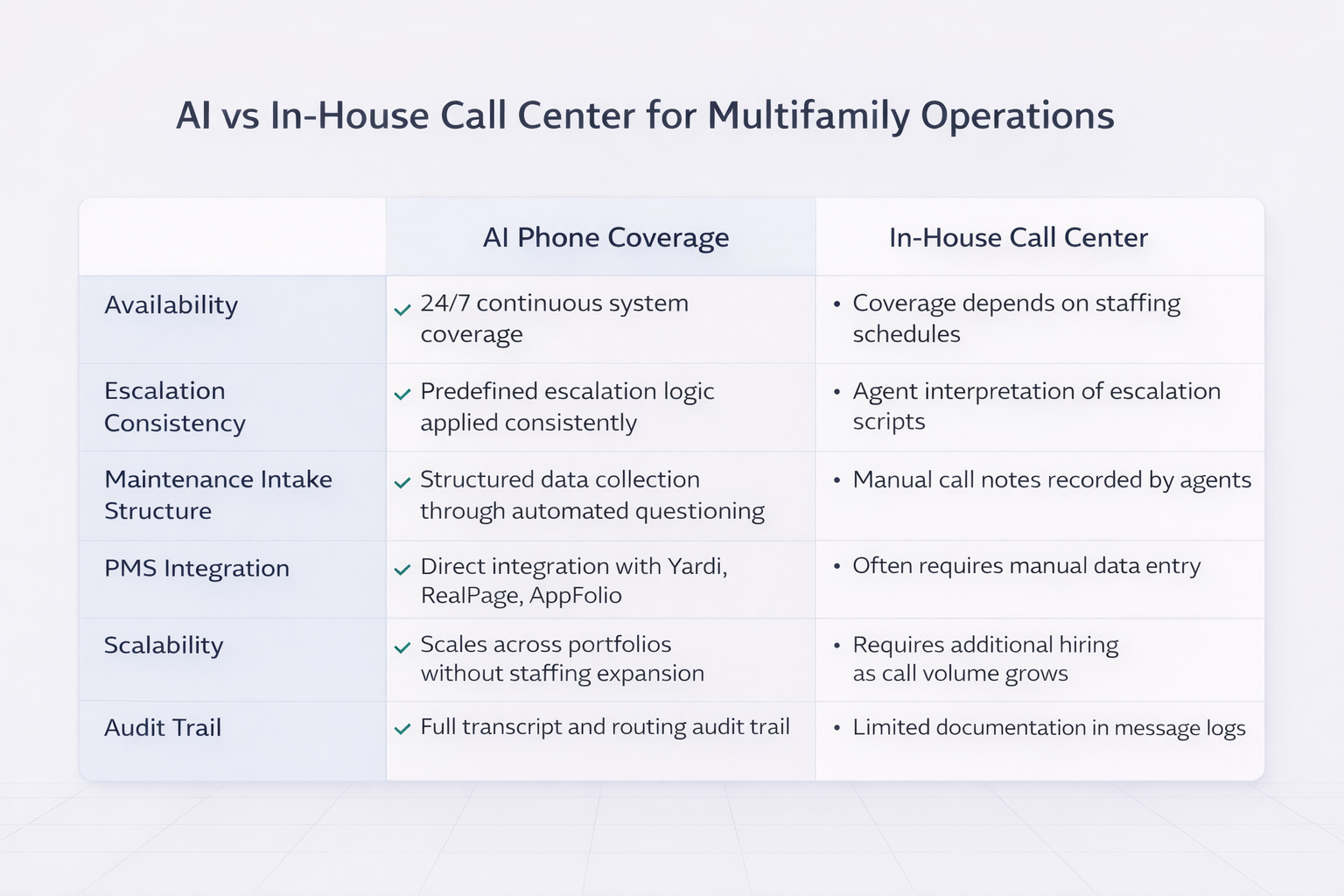
| Capability | AI Phone Coverage | In-House Call Center |
|---|---|---|
| Availability | Continuous 24/7 | Dependent on staffing |
| Escalation consistency | Predefined logic | Agent interpretation |
| Maintenance intake | Structured and standardized | Manual note-taking |
| Work order creation | Automatic, in Scaalr | Often manual entry |
| Scalability | Consistent across portfolios | Requires additional staffing |
| Audit trail | Transcripts and escalation logs | Limited documentation |
When internal call centers may still be appropriate
Internal call centers may be suitable when organizations prefer full control over resident communications or when call volume is high enough to justify dedicated teams.
They may also be used when property management companies centralize multiple communication channels, including leasing inquiries, resident services, and maintenance coordination.
However, internal teams still face operational variability when classifying maintenance issues and routing requests.
When AI-based intake becomes operationally relevant
AI phone coverage becomes increasingly relevant when organizations operate larger portfolios with standardized processes.
Typical indicators include:
- Portfolios exceeding 1,000 units
- Multiple properties operating under shared operational standards
- High after-hours call volume
- Frequent emergency escalation decisions
- Centralized operations teams managing intake
At this scale, the operational challenge is no longer simply answering calls. The challenge is ensuring requests are classified and routed consistently across the entire portfolio.
Structured intake systems are designed to address that requirement.
The operational question is not simply who answers the phone. The more important question is how consistently requests are classified, documented, and routed across properties.
US and Canada considerations
Both US and Canadian multifamily operators evaluate phone coverage models based on similar operational concerns. These include escalation reliability, structured intake, and documentation consistency.
US operators often prioritize vendor security posture, dispatch compliance, and structured intake. Canadian operators may also consider data residency requirements and provincial privacy regulations when evaluating technology platforms.
Despite these differences, the operational comparison between AI systems and internal call centers remains largely consistent across both markets.
Summary
Both internal call centers and AI-based phone coverage systems provide ways for property management organizations to handle resident calls.
The key difference lies in operational structure. Internal call centers rely on human staffing and interpretation. AI intake systems rely on structured workflows, predefined escalation logic, and automated routing.
For organizations managing large multifamily portfolios, the operational question is not simply who answers the phone. The more important question is how consistently requests are classified, documented, and routed across properties.
For a broader operational framework, see: 24/7 AI Phone Coverage for Property Management
See the full operational framework: AI Property Management Operational Framework.